What Actually Happens in a Return-to-Sport Test?
This article is for general information only and is not a substitute for individual physiotherapy assessment and advice.
You've put in the hard yards. Months of rehabilitation, early mornings, frustrating setbacks and slow progress. Your pain has settled, your strength feels like it's coming back, and you're itching to get back on the field, court, track, pool or pitch.
But there's a question that sits in the back of your mind: am I actually ready — or am I just hoping I am?
It's one of the most common conversations we have with patients at East Vic Park Physiotherapy. And it's exactly the right question to be asking.
Return-to-sport testing exists to answer it — objectively, clearly and honestly.
Why "Feeling Ready" Isn't Enough
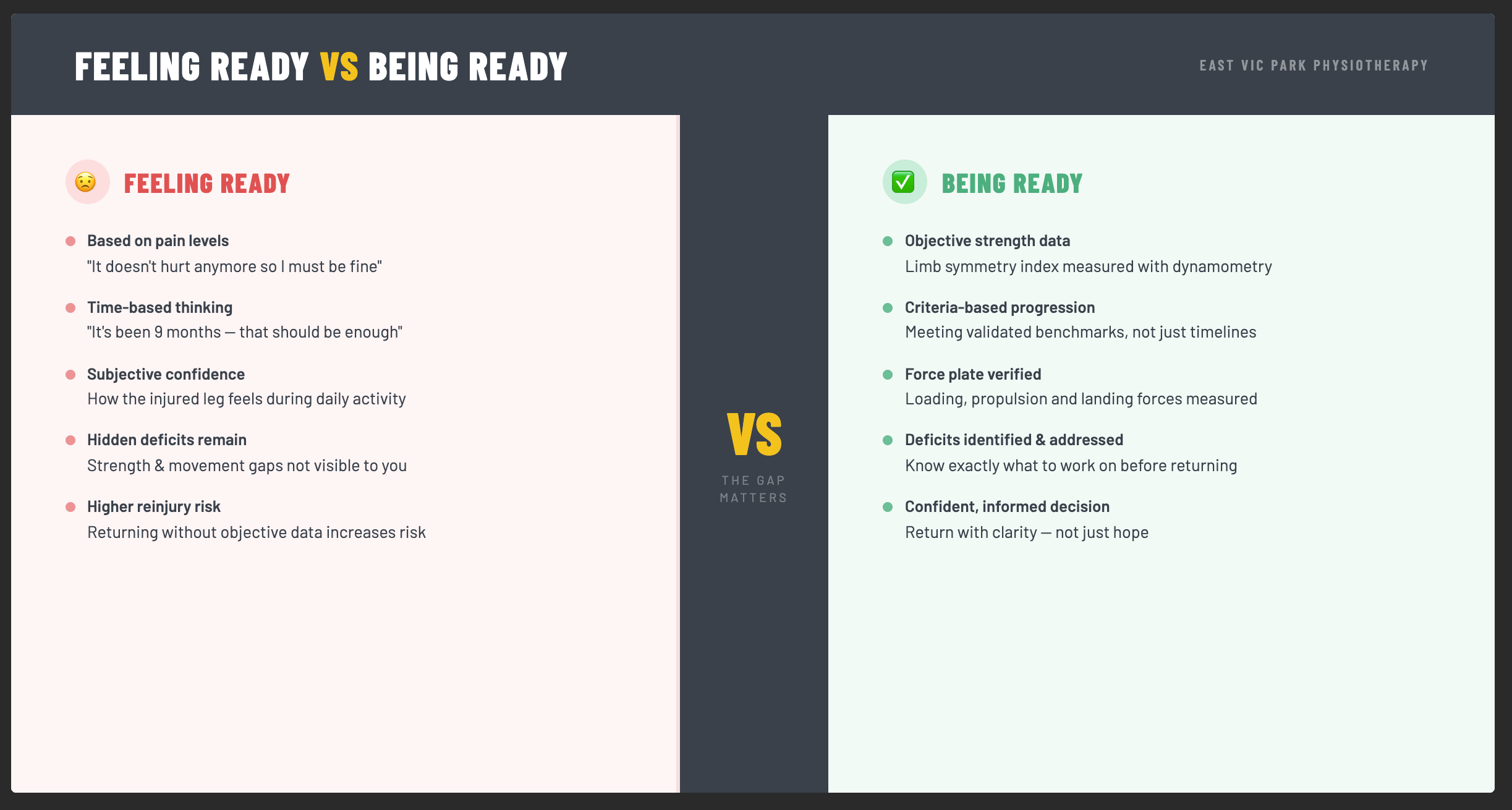
Here's something that might surprise you: research consistently shows that how ready you feel is not a reliable guide to how ready you actually are.
Many athletes who feel completely fine still have meaningful strength or movement deficits in their injured area — deficits that only show up when you measure them properly. And returning to sport with those deficits significantly increases your risk of reinjury.
The good news is that those gaps are measurable. And once you know where they are, you can address them — or make an informed, confident decision about returning.
That's what return-to-sport testing is for.
What Does a Return-to-Sport Assessment Involve?
At East Vic Park Physiotherapy, we use a combination of objective testing tools that go well beyond the standard "how does it feel?" conversation.
Here's what a typical session involves:
1. We Start With a Conversation
Before we touch any equipment, we sit down and talk. We want to understand your injury, your surgery if you had one, how your rehabilitation has gone, what sport you're returning to, and what your goals are.
This context shapes everything that follows. A 28-year-old netballer returning after an ankle reconstruction has very different testing needs from a 50-year-old cyclist coming back after a hip labral repair. Your testing is tailored to your injury, your sport and your body — not a generic checklist.
2. We Measure Your Strength — Properly
Not "can you do a squat" — actual, objective strength measurement using dynamometry and strength testing.
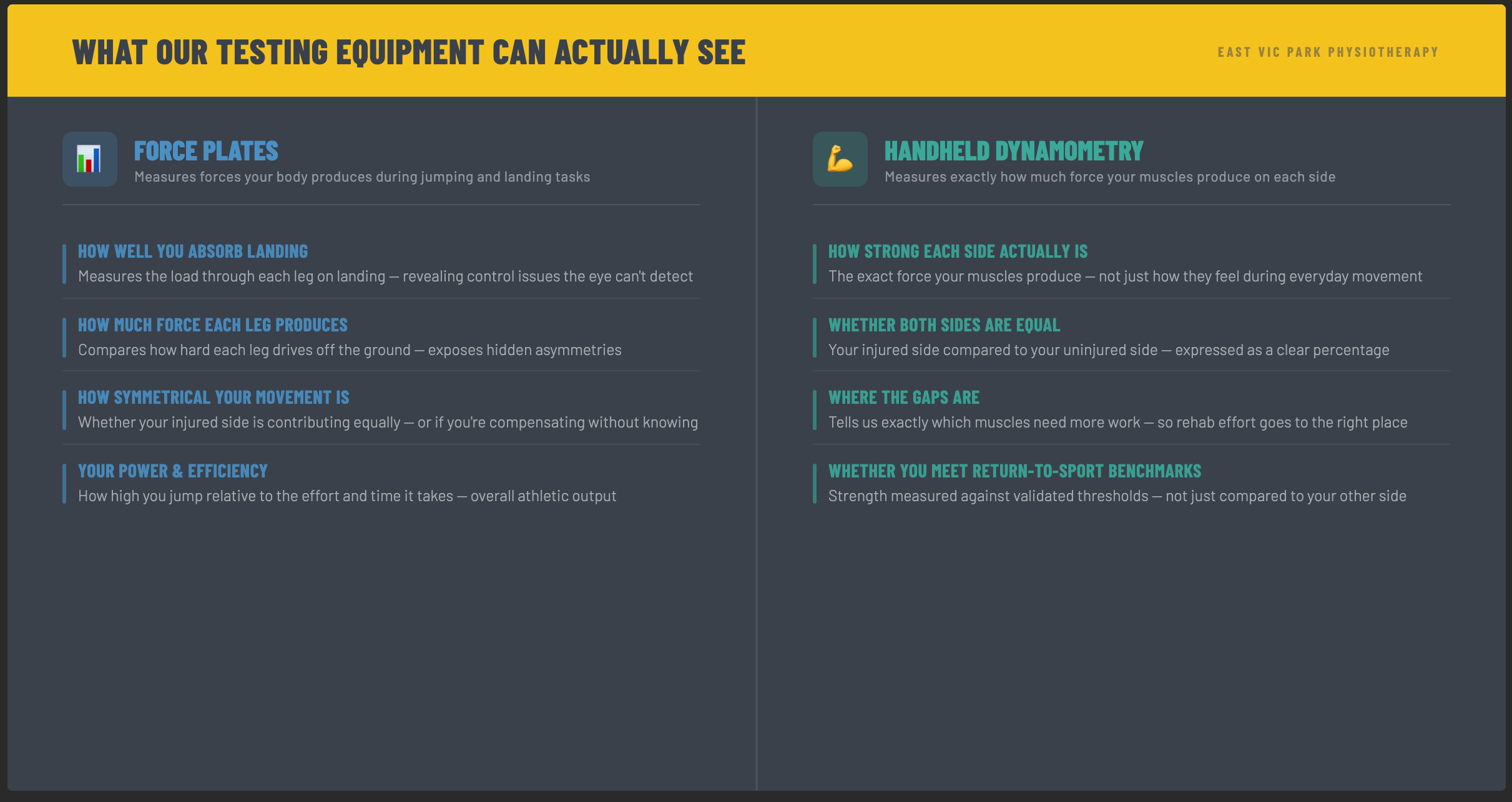
Dynamometry involves a device that measures precisely how much force your muscles can produce on each side. We compare your injured side to your uninjured side and calculate the difference — looking at the key muscle groups relevant to your specific injury and sport.
Why does this matter? Because strength asymmetry — even when it's not obvious to you — is one of the strongest predictors of reinjury risk. You might feel balanced and capable, but if one side is producing significantly less force than the other, that gap will be exposed under the full demands of sport.
3. We Use Force Plates to Measure What You Can't Feel
This is where our testing goes beyond what most clinics offer.
Our clinic has access to force plates — technology that measures the forces your body produces and absorbs in real time. For lower limb injuries, you'll perform a series of jump tests and the force plates capture detailed data about how each leg loads, decelerates and pushes off. For upper limb and shoulder injuries, we use force plate-based isometric testing — such as the Athletic Shoulder (ASH) test — which measures how much force your shoulder girdle produces across different positions and angles relevant to your sport.
Think of it this way: two athletes might perform the same movement, but the way they produce and absorb force can be very different. Force plates let us see things that the naked eye and simple measurements simply cannot detect.
What we're looking for is how symmetrical your output is between sides, how well your body is absorbing or producing force in the positions your sport demands, and whether there are any deficits that put you at risk. Research has consistently shown that even athletes who appear ready based on standard criteria often still have meaningful asymmetries that only force plate testing can reveal.
This information is valuable not just for the return-to-sport decision, but for guiding the final phase of your training.
4. We Test How Your Body Performs Under Real Sport Demands
The specific functional tests we use depend entirely on your injury and sport — there's no one-size-fits-all battery.
For lower limb injuries, this typically includes a series of single-leg hopping tasks — testing distance, speed and multiple directions — that assess a combination of strength, power, neuromuscular control and confidence in the injured side. For upper limb and shoulder injuries, we use sport-specific functional tasks that replicate the demands your injured area will face when you return.
Comparing performance between sides gives us another layer of objective data about how well your injured area has recovered. We use functional performance testing alongside force plate and strength data — not instead of them — because each tool captures something different, and the full picture is always more useful than any single test alone.
5. We Assess Your Balance and Movement Quality
Strength and power are important, but so is how your body coordinates and controls movement under load. We'll look at your stability and observe how you move during functional tasks relevant to your sport.
Sometimes an athlete has recovered their strength well but develops subtle compensatory movement patterns — ways of "working around" the injured area rather than through it. Left unaddressed, these patterns can increase injury risk even when strength and functional performance scores look good. Identifying them is an important part of a complete assessment.
6. We Check In on How You're Feeling Mentally
This one surprises some people — but it's backed by solid research.
Fear of reinjury is extremely common after significant sporting injury, regardless of what body part was injured. Many athletes describe feeling hesitant, holding back, or not fully trusting their body — even when physically they may be ready. Research shows that these psychological factors are genuinely associated with both performance and reinjury risk.
We use a brief, validated questionnaire to understand where you're at mentally. This isn't about passing or failing — it's about making sure we have the full picture, and that any concerns you have are addressed as part of your return-to-sport plan.
What You'll Know After Your Assessment
Once we've completed your assessment, we sit down and go through the results with you clearly and honestly.
You'll leave knowing:
How your strength and movement compare between both sides and against established benchmarks
Whether there are any specific areas that need more work before you return
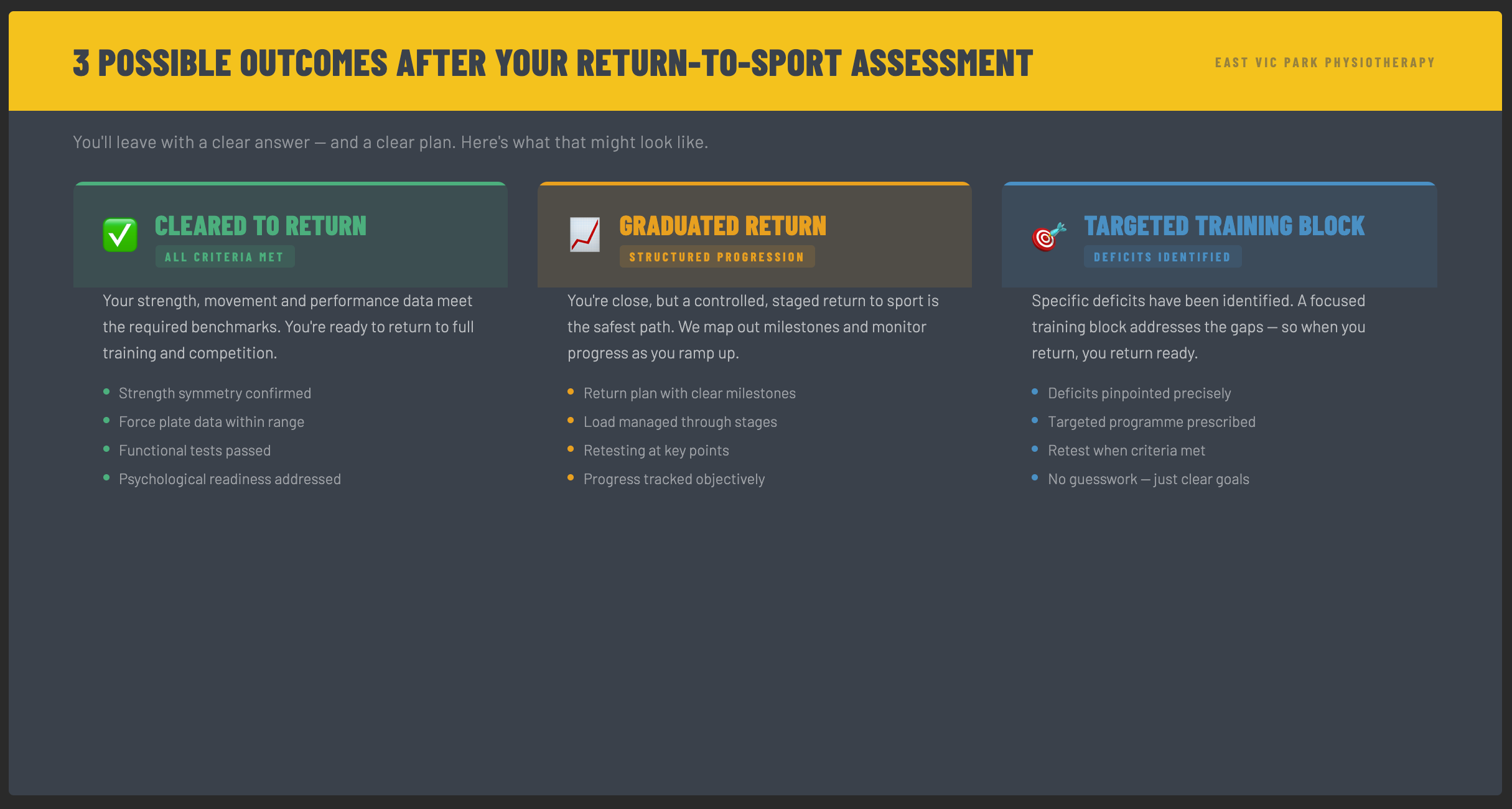
A clear recommendation — whether that's a confident return to sport, a structured graduated return, or a targeted training block to address specific deficits
We don't just hand you a score and send you on your way. We explain what the results mean in plain language, answer your questions, and map out exactly what the next steps look like.
With your permission, we can also share results with your surgeon, specialist, coach or trainer — because good communication between everyone on your team leads to better outcomes.
Who Is Return-to-Sport Testing For?
You don't need to be an elite athlete to benefit from this kind of assessment. We work with people across a wide range of sports, ages, activity levels and injury types, including:
Athletes recovering from surgery — knee, ankle, hip, shoulder or other
Overhead athletes returning after shoulder reconstruction or stabilisation
Anyone who has completed rehab but isn't sure they're ready to go back
Athletes who want objective data before committing to full training or competition
Active individuals who want to reduce their risk of reinjury on return
Parents or coaches supporting an athlete through the return-to-sport process
If you've worked hard through rehabilitation and want a clear, honest picture of where you're at — this assessment is for you.
What Return-to-Sport Testing Can — and Can't — Do
Return-to-sport testing won't eliminate every risk. Sport is inherently physical, and injuries can happen to anyone.
What testing does do is give you the best available information to make a smart, confident decision. It replaces guesswork with data. It identifies the gaps that matter. And it gives you — and your whole support team — a clear, honest picture of where you're at.
After months of hard work in rehabilitation, you deserve that clarity.
Ready to Find Out Where You're At?
Our team at East Vic Park Physiotherapy provides return-to-sport testing for athletes and active individuals across Perth, including Victoria Park, Carlisle, Lathlain, South Perth and surrounding suburbs.
If you're approaching the end of your rehabilitation and want a confident, objective answer to the question "am I ready?" — we'd love to help.
Frequently Asked Questions
How long does the session take?
Most assessments take between 30-60 minutes. We take the time to do it properly.
Do I need a referral?
No referral needed — you can book directly.
Is this only for knee or lower limb injuries?
Not at all. We provide return-to-sport testing for a wide range of injuries — lower limb, upper limb and shoulder. Our force plate testing includes both lower limb jump analysis and upper limb isometric testing for overhead and contact sport athletes. The specific tests we use are always tailored to your injury and sport.
Do I need to be pain-free beforehand?
Not necessarily — it depends on your injury. Give us a call and we can talk through what's appropriate for your situation before you book.
Can I do repeat testing to track progress?
Absolutely. Many patients find it valuable to test at multiple points through rehabilitation to track their progress and know when they're ready to step things up.
What should I wear?
Comfortable exercise clothing and sport-specific footwear if you have it.